
ClearMash Brain
The Enterprise Knowledge Orchestration Layer: One Brain that holds what your organization knows, how your organization works, and the context that decides which of them applies right now.
Improve what the organization knows. Apply it to the case in front of an employee, a customer or an AI agent. Learn from what the work sends back.
-
What does this customer’s plan actually cover?
- What are we allowed to offer in this situation?
- What changed in the policy last month?
- What is the current version of this procedure?
-
Which of these accounts can they open?
- Which method applies to this model and this variant?
- Which form does this case need?
- Which rule was in force when this was agreed?
-
Who has to approve it before it goes out?
- Who owns this page, and are they still here?
- Who do I escalate this to at this hour?
- Who is allowed to see this answer?
-
When does the exception apply?
- When did this take effect, and for whom?
- When does this customer’s cooling-off period end?
- When do I hand this to a service agent?
-
Where does this case go next?
- Where is this procedure different at this site?
- Where is the part for this job held?
- Where is the authoritative version of this?
-
Why does the rule apply here and not there?
- Why was this customer told something different in September?
- Why did the AI agent say that?
- Why is this the recommended option here?
-
How do I finish it without asking a colleague?
- How is this handled when the system is down?
- How much of this can an AI agent do on its own?
- How do I prove later that we applied it correctly?
Content tells you what was written. A Brain understands what it means.
The distance between what was written and what it means is where most of the cost sits.
A document records a decision someone made once, in the language that made sense to whoever wrote it, for the situation that existed at the time. It does not know who is reading it. It does not know the rule changed in April. It does not know that this customer is an exception, that this market has an extra requirement, or that the procedure it describes was quietly replaced in a recent release.
A Brain holds the same subject matter differently. It holds what the organization currently means, which parts of that apply to the situation in front of you, and what should happen next. It knows that the same rule has to reach a specialist, a new hire, a customer and an AI agent, and that each of them needs it expressed differently without any of them being told something different.
Understanding, in this context, is concrete. It means knowing that sentences in different documents describe the same rule, that only one of them is current, that the rule applies to this customer because of their contract date, and that the correct next step is a specific action rather than a paragraph to read.
The rule changed in April. The agreement was signed in February.
The right thing is done, in every channel.
From scattered content to one Brain: What, How and Context filed once, put to work for employees, customers and AI agents - and what comes back improves the Brain.
What Facts · Offerings · Rules
- Refund policy
- Price list
- Contract
- Catalog
- Spec
- Terms
- Offer
- Regulation
- Eligibility
- FAQ
- Rate card
How Procedures · Skills · Decisions
- SOP
- Script
- Playbook
- Checklist
- Procedure
- Training deck
- Guide
- Macro
- Prompt
- AI agent skill
- Troubleshooting
Context Decides which What and which How to act on
- Who Segments
- When Effective dates
- Where Market rules
- Which Variants
- Why Rationale
- Employeesguided flows, comparisons, procedures and checklists
- Customersan answer
- AI agentscode: what, how and context to act on
- The gaps improve the Brain
- Content
What was written down, wherever it currently lives.
- Knowledge
What the organization actually means by it, current and approved.
- Context
Who, when, where and which. The conditions that decide what applies.
- Decision
What follows from those conditions, and why.
- Know-how
How the work is performed, the way the organization approves it.
- Action
The task completed, by an employee, a customer or an AI agent.
- Outcome
What happened, and what it teaches the Brain next.
Every step depends on the one before it. Skip the middle and you are back to search.
Your knowledge has new readers, and it changes faster
Organizational knowledge used to have one kind of reader: an employee, with time to interpret it, a colleague to ask and the judgment to notice a stale page. That reader is still there. Beside them now sit customers helping themselves at midnight, partners working from your documentation, and AI agents that read exactly what they are given and act on it.
The same knowledge has to hold for all of them. It was written for the first one, and it moves faster than it used to. Products, prices, policies and regulations change on their own schedules, each change reaches some channels before others, and every channel a step behind is giving an answer the organization no longer stands behind.
The instinct is to fix it with tooling. A better intranet. Better Enterprise Search. A better assistant. Each helps at the margin. The cause is knowledge never made good enough to apply without interpretation.
Change velocity
Products, prices, policies and regulations move faster than the documentation describing them. The gap between the change and the documentation is where wrong answers live.
Channel spread
Phone, chat, portal, branch, field, partner, AI agent. Every additional channel is another opportunity to diverge from the others.
AI in production
An AI agent reads everything it is given, including the version nobody meant to keep. It cannot tell which one the organization stands behind.
Expertise leaving
The knowledge that was never written down walks out at the end of someone’s notice period, and the questions it used to answer do not stop arriving.
A Brain is how an organization keeps saying one thing to every employee, customer and AI agent, while the rules and the readers keep changing.
The WH model
WHAT and HOW are the substance. Context decides which version of it applies.
It is easy to stop at What. Confirming that the policy exists and finding the page it sits on is the part that already feels solved. The organization’s real difficulty starts one step later, where someone has to apply that policy to the case in front of them and do something about it.
How is the half that usually goes unmanaged. It lives with experienced people, in team habit, in the way a good service agent handles a difficult call. It is rarely written in a form anyone else can apply, and almost never in a form an AI agent can follow. When an organization says it has a knowledge problem, this is usually the half it means.
This is why an organization can have excellent documentation and still perform inconsistently. The documentation describes What in detail and leaves How to the reader. Two competent employees read the same page and do two different things with it. Both are defensible, neither is identical, and the customer experiences the difference.
Context is what turns both into an answer. The same product carries different rules in two markets. The same policy has different effect before and after an effective date. The same procedure changes when the customer is a business rather than a consumer, or when the request arrives outside working hours. Without context, a correct answer is still the wrong answer.
The organization’s facts, offerings, rules, policies and knowledge. What you sell, what it includes, what is permitted, what is required, what a term actually means.
The organization’s procedures, skills, decisions and ways of working. How a case is handled, how a policy is applied, how a task is completed correctly and consistently.
The context that determines which What and which How apply in the situation in front of you, and the reason behind the action when someone asks for it.
Take an ordinary decision: whether this charge stands. What names the fee and the product it belongs to. Which identifies the variant the customer actually holds. Who establishes whether their status exempts them. When decides whether the change that removed the fee reaches an agreement signed before the effective date. Where decides whether this market adds a requirement of its own. Why supplies the reason, in language that can be given to the customer in writing. How completes it: waive it, explain it, escalate it, or record it. One situation, each part of it named, one action taken, and far less left to interpretation.
WH turns information into action.
What applies, in this situation, for this customer or employee, product, place and time, why it applies, and how to move forward.
What belongs in the Brain
You already have the raw material.
Products and services
What is offered, what it includes, what it costs, what it requires and how variants differ.
Policies and regulations
What is permitted, required, prohibited and exceptional, and when each took effect.
Procedures and SOPs
The steps that complete work correctly, including the ones that matter most under pressure.
Decision criteria
The conditions that change the outcome, and the reasoning behind the change.
Professional expertise
The judgment specialists apply, made available to people who are not specialists.
Forms and guidance
What has to be collected, in what order, and what happens if something is missing.
Training knowledge
What a new employee has to understand, connected to the work rather than to a course.
Organizational know-how
The practices that make experienced people effective, written so others can use them.
AI-agent skills
How an AI agent should perform a task, what it must check, and where it must stop.
Approved ways of working
The version of the process the organization is prepared to stand behind.
The hardest category is the one that was never written down. It is held by people who have handled ten thousand cases and can tell you in a sentence what to do about the eleven thousandth. Getting that into the Brain starts with the questions real work keeps asking, and with the people who already answer them informally.
The Brain does a large part of that work itself. It learns from the questions people and AI agents actually put to it, including the ones it answered poorly, so a gap arrives as a specific question rather than as a suspicion. It reads its own material and says where an answer is thin, missing, or contradicted by something else it holds. And it takes in the places the work already leaves a record - the service desk and its ticket history, the mail thread where a decision was made and never written up anywhere else - so a specialist is correcting a draft rather than facing an empty page.
The deployment phase builds on what you already have
- Knowledge Mapping
We map your first business area with you: the knowledge it runs on and who owns each part.
- Content Connectivity
The Brain connects to your content where it lives, in your systems, file servers and websites.
- Go-Live
Employees, customers and AI agents draw on the Brain in the channels they use today, under your own approvals and permissions.
- Enterprise Rollout
The next business area joins the same Brain, with its own owners and channels, and starts from the knowledge the Brain already holds.
- Continuous Improvement
Every case, correction and outcome sharpens the knowledge your people and AI agents act on.
Pango: six weeks from the first workshop to launch. The Pango story
The Brain is what your content becomes once the organization has decided what it means.
Focused by design
A Brain earns trust by holding only what it can keep right.
Customer records, transactions, orders, employee records, operational events and enterprise databases belong in the systems built to manage them, with the controls, guarantees and lifecycle those systems already provide.
The Brain draws on current information when the situation requires it. An account status, an order date, a contract type, a claim stage. It uses that fact to work out which knowledge applies, and then contributes what the fact means and what should happen next.
The boundary is what makes the Brain adoptable. Your records stay in the systems that keep them, each of those systems keeps the job it already does, and every team keeps its own data while the organization gets one understanding of what that data means.
The alternative approach is to pull the whole enterprise into one place, also known as a data lake, and reason over it. It makes an appealing diagram and a long program: years of integration, a standing governance argument, and a single point at which every access decision in the company is settled again. Meanwhile the failure that actually costs money, two channels giving two answers about the same policy, is not a data problem at all.
Customer records. Transactions. Orders. Claims. Inventory. Employee records. Operational events.
Products. Policies. Regulations. Procedures. Decisions. Expertise. Skills. Approved ways of working.
The current fact is interpreted through the organization’s knowledge, and an answer or an action follows.
The system of record knows the fact. The Brain knows what the fact means.
The Brain sits between the systems you already run
It reads from the places your facts and your written material already live, and it answers inside the tools your people and your AI agents already work in.
The Brain works out which of what it reads applies to the situation in front of someone. Your records stay in the systems that keep them and your channels keep the traffic they already carry, so adoption starts with a connection rather than a migration.
Knowledge is governed in one place and put to work everywhere it is needed, so one correction reaches every channel, every workflow and every AI agent at once. Orchestration moves knowledge; a Brain makes that knowledge worth moving.
A system is usually both a source and a destination. The Brain reads the account from the CRM and answers inside the same record; it reads the pages on your website and answers on that same website, in the customer’s own words.
What the Brain reads from
- Sites, documents and files Everything the organization has already written down, wherever it currently lives.
- CRM and customer records Who this customer is, what they hold, and what has happened on the account.
- Product, pricing and operational systems What is in force today: the plan, the price, the stock, the order, the claim stage.
- Service desks and ticketing The case in front of someone, and how the last one like it was closed.
Knowledge orchestration layer
ClearMash Brain
What · How · Context
What the facts mean, and what to do next.
Where the Brain answers
- CRM and service desks Beside the record or the case that is already open, without a second window.
- Contact center and chat Into the live conversation, in the channel the customer chose to use.
- Websites and self-service The same answer in public, without the internal vocabulary.
- AI agents and assistants As the knowledge and the skill an AI agent is handed before it answers.
Which systems belong on each side differs in every business area, and agreeing that list is usually the first useful hour of the deployment phase. A contact center starts from the queue and the case. A branch network starts from the product terms and the rule that governs them.
Knowledge Sovereignty needs a platform of its own
Take the optimal case: the knowledge capability inside a product you already own is excellent. It still sits inside one of the places your answer is used, on that product’s release cycle and under that product’s governance. What decides it is where knowledge sits.
The owner of the answer cannot be one of its consumers
The same rule has to hold in the CRM, on the website, in the phone system, at the counter and in every AI agent your teams are building. Whichever of those holds the original, the rest hold copies, and a copy is inherited rather than maintained. Give it two quarters and you no longer have one policy in several places. You have several policies, each defensible, and none of them the organization’s.
Every AI agent multiplies the cost of being wrong
AI agents are being built across your organization right now: in the service platform, the sales platform, a central team and a partner’s product. Feed each from whatever its own host happens to hold and you have not deployed one organizational understanding several times over. You have deployed several understandings once each, at machine speed, with nothing accountable for the difference between them. Each AI agent you add multiplies that, and one layer underneath all of them is the only thing that divides it.
Knowledge keeps a different clock than software
The CRM gets replaced. So do the contact center, the AI agent framework and the model underneath it. A suitability rule, a safety procedure and a product catalog run on none of those schedules, and many of them outlive every system that has held them. Kept inside one of those systems, knowledge has to be rebuilt each time the system turns over. Records export cleanly; meaning needs a home of its own.
Governance has one owner or it has none
When something goes wrong, the question is what the organization said on the day of the decision, which version was in force, who approved it and who was entitled to see it. That has an answer only where approval, effective dates, history and access rules sit together. Spread across the products that each hold a copy, there are several records and no organizational position.
A specialized product with vast experience, not a tab inside one
Making knowledge fit to act on is work in its own right: taking in what you already have in the shape it arrives in, deciding what is still in force, finding where two documents disagree and getting a knowledge owner to settle it, finding the exception nobody wrote down, approval before anything publishes, the earlier version and the date it took effect. Each of those is a workflow with an owner and a queue, and ClearMash Brain is built around them. Over time, no add-on can match a platform dedicated to that work.
Separate in ownership, integrated in delivery. One owner and one lifecycle for what your organization knows, with every answer arriving in the tools where the work already happens.
Knowledge Sovereignty is your organization’s ability to:
- State it. One place that says what your organization knows about any rule.
- Prove it. What it said on any date, which version was in force and who approved it.
- Control it. One rule for who and what may use it, binding people and AI agents alike.
- Move it. All of it comes with you when a system around it is replaced. No vendor lock-in: every ClearMash customer can export all of their data and move to a different vendor at any time.
Your organization’s knowledge is what your software exists to apply.
The systems around the Brain will keep changing. What your organization knows stays yours through all of them.
What a Brain is made of
ClearMash Brain holds hundreds of features, skills, pipelines, AI models and years of experience. Here are some of the components it has.
Want to see more?
Book a Demo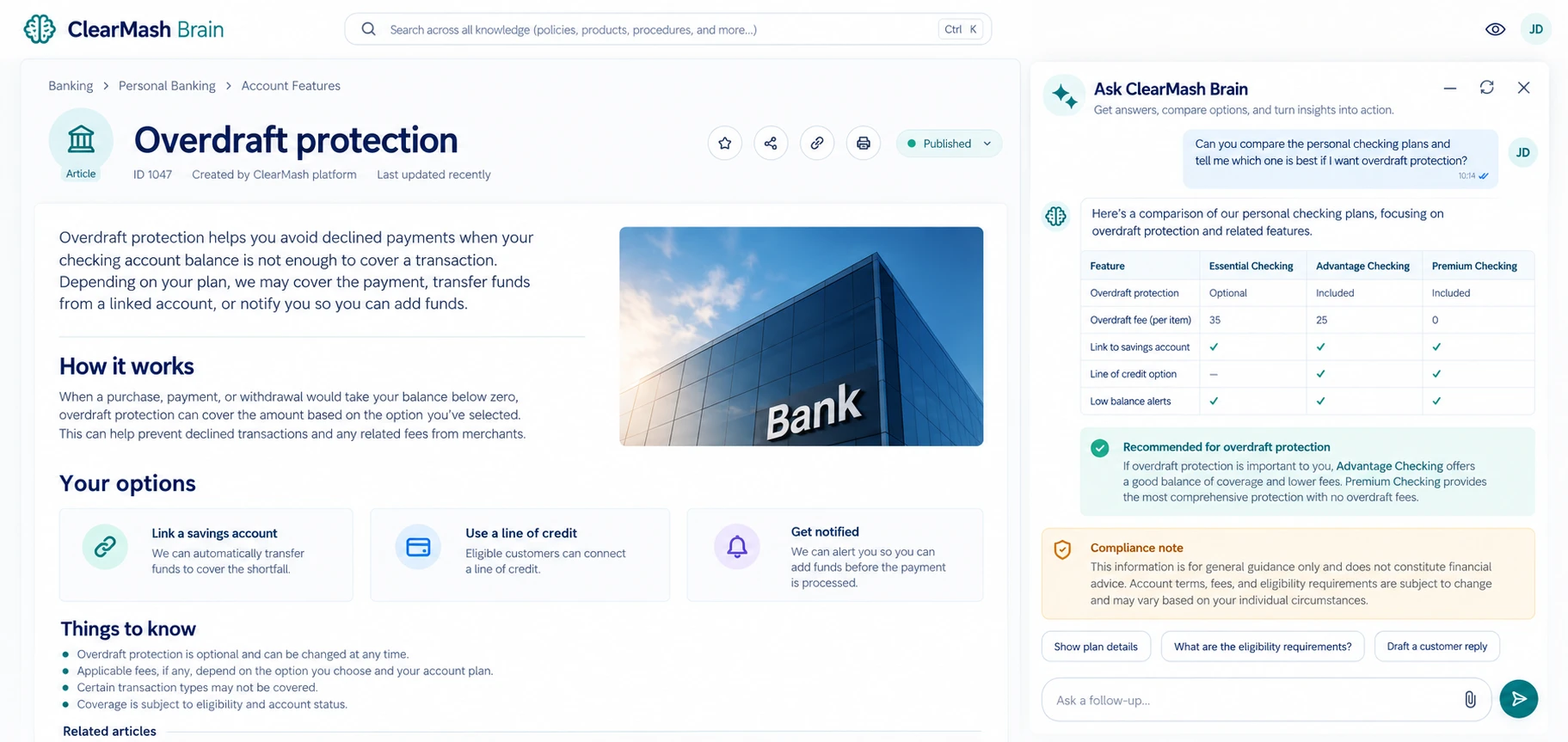
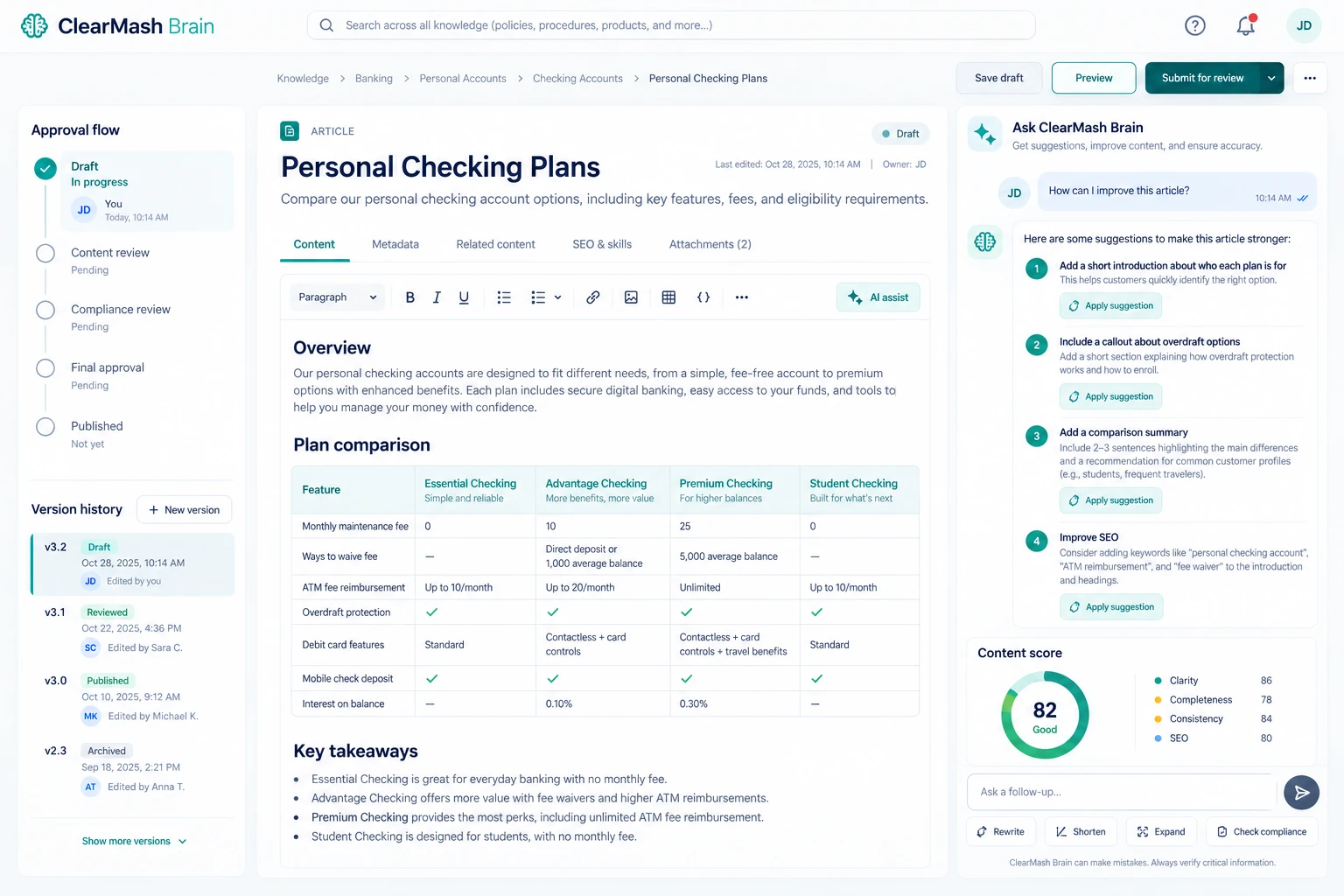
How knowledge is learned, written and agreed
- Learned from your sources. The Brain learns from what your teams already produce, from documents and sites to the cases closed in your CRM, and suggests edits to the owner of each item.
- Authoring in place. Editors work on the knowledge item itself, in a template built for that kind of item, with the fields that kind actually needs.
- A path to approval. Draft, content review, compliance review, final approval, published. Each step has an owner, and nothing reaches a reader before its step is done.
- Every version kept. What the previous version said, who changed it, why it changed, and which state it was in when somebody acted on it. A kind of item can be set to require that reason before a new version exists at all.
- Effective dates. A rule that changed in March is the current rule after March and the previous rule before it. Both stay available, and both stay distinguishable.
A knowledge owner should be able to say, about any sentence the organization has published, who approved it and what it said last quarter.
How it reaches employees, customers and AI agents
- Permissions that follow the organization. People and AI agents receive what their role is allowed to receive, down to the single field of an item, under the structure the organization already maintains.
- One meaning, many languages. Languages like English and Spanish, and the languages inside a business: the terms experts use and the words customers use. Editors write once, and the Brain translates between all of them from the same approved meaning.
- Guided procedure. A procedure arrives as steps that ask and answer, narrowed to the case in hand.
- Comparison and calculation. Where a decision turns on comparing options or working out a figure, the knowledge item does that work.
- Inside the working system. The answer can appear in the system somebody is already in, prompted by what they are doing there.
All of it comes down to what an employee, a customer or an AI agent actually receives: the comparison this case needs, the recommendation that follows from it, the cost of that recommendation said out loud, and whatever your organization requires to be said alongside it.
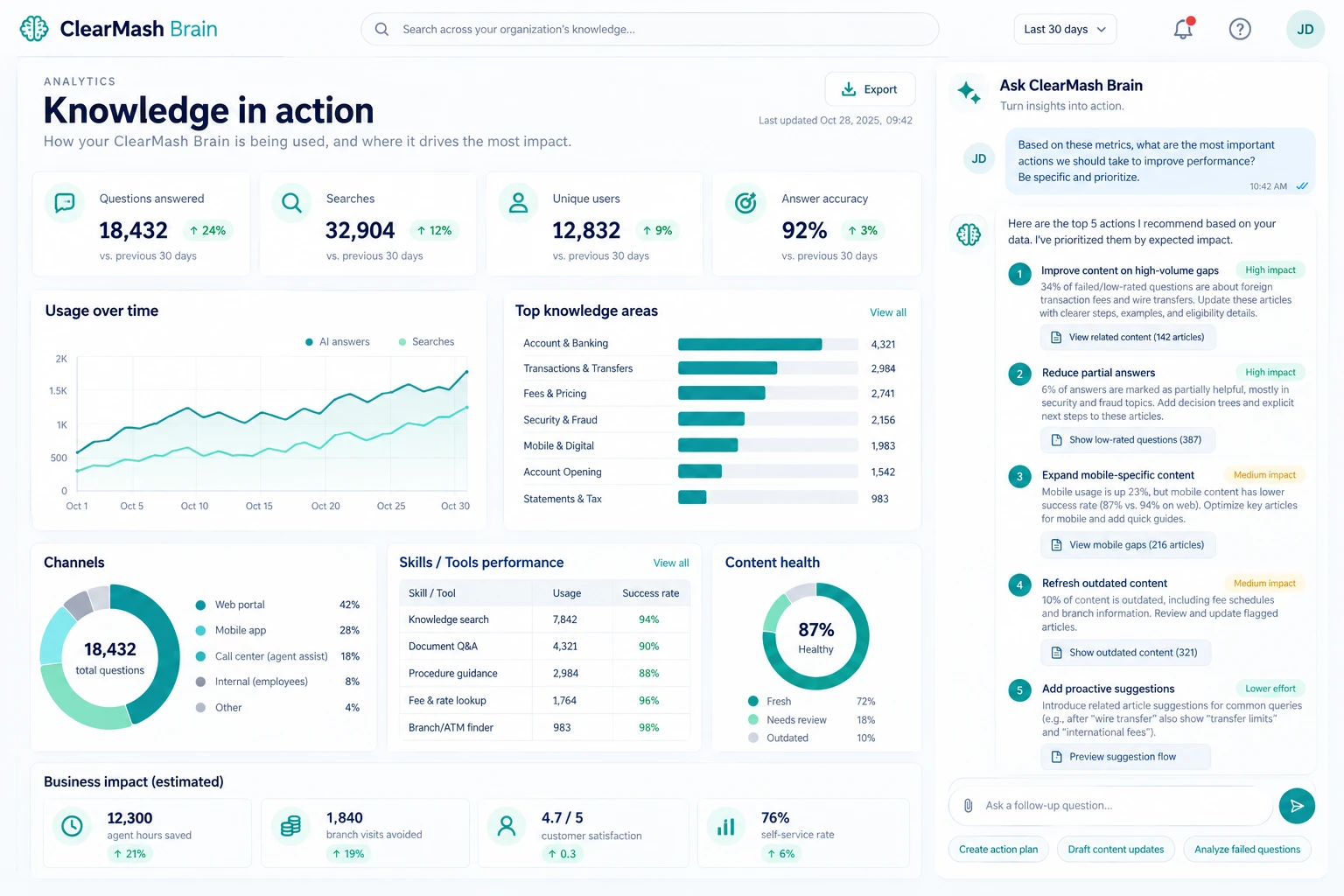
What comes back from use
- Feedback from employees and AI agents. Anything they receive can be marked wrong, thin or out of date, on the item itself.
- Feedback from customers. How customers rate the answers they get, and what they say was missing.
- Implicit feedback. Which search result was chosen, which item people moved to next, and which searches found nothing.
- Call and chat transcripts. What customers actually asked, in their own words, and how each case was handled.
- A queue, in priority order. All of it arrives as work: the gap behind the most failed questions first, with the articles it affects.
Use is the truest test of knowledge, and a question that got a poor answer is evidence about the knowledge behind it.
What it does on its own
- It reads its own content against itself. Two items that say different things about the same subject. The same passage sitting in several items. A question that is already answered somewhere else under another name. It finds them and names the items, and leaves the knowledge owner to decide which one is right.
- It knows what has gone out of date. Which knowledge is current, which is waiting for its reviewer, and which has quietly stopped being true. An item marked out of date points at the one that replaced it, and an answer that was verified stops counting as verified the moment the document under it changes.
- It works to a standard your organization sets. What a good item of each kind has to contain, and the words your organization uses for things, are written down once and held per kind of item. Each item is then scored against that standard, and against how the rest of your material is written, and the editor sees both while they are still writing.
- It tests its own answers. The questions your organization actually has to answer, run against the knowledge as it stands, on a schedule, and scored against the answers already known to be right. Whole conversations can be judged the same way before a customer has one. An editor sees what that came to on their own item: which questions it answered, and which it was held back from answering because it did not answer them well enough.
This is what keeps the rest working a year from now: the Brain reads its own material on its own schedule, and what comes back is specific enough to act on.
Many more parts keep your knowledge right, among them a template for every kind of item, changes sent out to be read and signed, a summary of what changed in an item, a check that outbound links still work, and an expert reachable from the article that raised the question.
As your business changes, your Brain changes with it.
Every change in the business is a change in its knowledge.
Products launch and retire. Regulations change, sometimes with an effective date that splits your customer base. Procedures evolve. Exceptions appear and become permanent. Customer questions shift after a campaign. Employees find better ways to work. AI agents reveal gaps an employee would have covered for. Business results expose friction.
Continuous improvement is the structure that keeps pace with a business like that. So the Brain is built to be edited by the people who own each area of knowledge, with change reaching every audience at the same time.
When a policy changes on Tuesday, the employee, the customer page and the AI agent all have the new version on Tuesday.
AI should strengthen organizational expertise, not disconnect from it.
Each is the other’s quality control.
Your experienced people know things that have never been written down, and they are the reason some processes work. Captured in the Brain, that expertise serves the whole organization, including the AI agent handling a call at midnight.
AI returns the favor in an unexpected way. AI agents fail loudly and consistently at exactly the points where organizational knowledge is thin. An employee encountering a gap improvises, asks a colleague and moves on, and the gap stays invisible for years. An AI agent hitting the same gap produces a visible, repeatable, reviewable failure, and that failure is diagnostic information.
- Expertise improves the Brain
What specialists know becomes something the organization holds, not something it borrows.
- The Brain strengthens AI
AI agents work from what the organization approves rather than from whatever was reachable.
- AI exposes the gaps
Failures cluster where knowledge is missing, contradictory or unusable in its current form.
- The gaps improve the Brain
Knowledge owners fix the cause once, in one place.
- Everyone benefits again
Employees, customers and AI agents all feel the same correction.
An organizational intelligence loop, running continuously, in the direction of better.
AI performs better when it has less to guess.
A powerful model is half of the answer.
A model arrives knowing a great deal about the world and nothing about your organization. Everything it knows about you, it was handed. If what it was handed is contradictory, out of date, too broad or silent on the exception, the model will still produce a fluent, confident answer, because that is what it is built to do.
The ways this goes wrong are business problems before they are technical ones.
Wrong knowledge
The AI agent holds inaccurate or conflicting knowledge and cannot tell which version the organization stands behind.
Wrong context
The AI agent receives information that does not apply to this customer, this market, this product version or this date.
Too much context
The AI agent receives everything that might be relevant, which raises complexity, latency and cost, and buries the part that mattered.
Weak know-how
The AI agent has information but no clear organizational skill for performing the task, so it invents a method and performs it differently each time.
Context economy matters more than it sounds. Every task an AI agent performs carries organizational information with it, and that volume is a cost multiplied by every interaction, every day, in every channel. Handing an AI agent a smaller and better-selected body of knowledge is cheaper, and it removes the material the agent could have misapplied: the same reason a well-briefed new employee outperforms an over-briefed one.
The model brings intelligence. ClearMash Brain brings your organization’s knowledge and know-how.
With those fixed, the AI agent has less room to guess: fewer unsupported answers, more consistent behavior between AI agents, less context carried per task, and fewer times an employee has to review the machine’s work before a customer sees it.
Better AI starts with a better Brain, and the Brain is the part you actually control.
Employees, customers and AI agents work from one Brain
Knowledge owners decide what it says.
Employees
Guidance in the flow of work, in the depth an employee needs, with the exception surfaced before it becomes a mistake rather than after.
Customers
The same organizational meaning, expressed as a straightforward answer or a guided path, without the internal vocabulary.
AI agents
The knowledge relevant to the task, plus the skill describing how the organization performs it, and the boundary where it must hand back to an employee.
Knowledge owners
The people accountable for products, policy, compliance, service or training. They decide what the organization says, see where it is failing in practice, and change it once for everybody.
Knowledge owners are the reason the rest stay aligned. Where ownership is clear, a position is stated once and corrected once. Where it is not, each channel drifts into a position of its own, and none of them is wrong enough to trigger a fix.
So the Brain gives the business owner of each area a way to state what is true, see how well it is working, and improve it, with the change reaching every employee, every customer and every AI agent at once.
All of it comes from one place. Organizations usually arrive here with a separate store for each audience: an intranet for employees, a help center for customers, a policy library for compliance, a folder of prompt files for AI. Each has its own update cycle, its own chance to fall behind, and no reliable way to tell which one a given answer came from.
In customer-facing environments the Brain acts as your Customer Communications Management (CCM): behind every letter, notice, statement and bill your customers receive, it ensures the right message reaches the right customer. It composes each one from approved templates and the customer’s data in your CRM, ERP and marketing platforms, sends it by email, SMS, portal, app, social media or print, and keeps it on record, retrievable per customer for audit.
One organizational meaning, reaching everyone who works from it, with far less room to drift apart.
A Brain changes how the organization performs
Numbers that move, and the mechanism behind each one.
Business impact
- Increase in customer satisfaction 15%
- Increase in first contact resolution (FCR) 40%
- Increase in self-service adoption 30%
- Increase in employee satisfaction 62%
- Reduction in inquiry handling time 28%
- Reduction in expert escalations 65%
- Reduction in new employee onboarding 70%
- Reduction in compliance violations 14%
Technological impact
- Reduction in AI costs 74%
- AI agent accuracy from 85% to 97%
- Increase in AI agent speed 25%
Faster execution
Work moves without a search phase in front of it, and without the interpretation phase after that.
Better human performance
New employees become useful sooner and experienced ones stop being a queue.
Better AI performance
AI agents that work from approved knowledge and defined skills, with less room to guess.
Better customer outcomes
The same answer in every channel, arriving on the first attempt more often.
Lower business risk
Policy applied consistently, change reaching everyone, and a record of what was published when.
That is the whole business case, and every part of it is measurable with instrumentation your operation already has. Handling time. Escalation rate. Self-service completion. Time to competence. Consistency across channels. Context consumed per AI task.
When knowledge becomes reliable, people stop building private workarounds: the personal spreadsheet, the team’s own cheat sheet, the senior colleague messaged directly because it is faster than looking. Those workarounds appear in no report, and they are a large part of why organizational change takes a year to land.
Better knowledge. Better decisions. Better execution.
Trusted by knowledge-intensive organizations












Every answer can be traced to what the organization approved
A Brain that influences decisions, customer answers and AI agent behavior has to be governed like something that matters.
The question an enterprise asks is who could change what the organization says, whether that change would be visible, and whether an answer given to a customer six months ago can still be explained today. Those are governance questions, and they have to be answerable in an audit rather than in a datasheet.
Ownership and approval
Every area of knowledge has an owner, and change follows an approval path rather than a good intention.
Access control
People and AI agents receive what they are authorized to receive, under the organization’s own rules.
Traceability
What was published, by whom, when, and what changed since.
Human in the loop
AI may assist the Brain. Your organization remains in control of what it knows and how it works.
Security, privacy and certification detail lives on the Security page, where it can be read properly.
See a Brain decide what applies
Book a demo and we will show you knowledge approved once and applied everywhere: in an employee’s window, in a customer’s answer and in what an AI agent does next.
What the organization means. How the work is done. The context that decides.
Prefer to start with the numbers? The impact estimator works them out